Build a Pantry With Cabinets That Survive Canned-Goods Weight and Humidity Swings
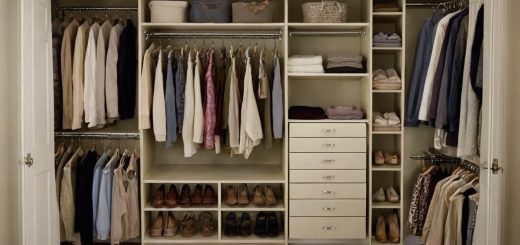
A pantry shelf that bows under canned goods gives little warning. The wood fibers stretch quietly over months until you open the door one Saturday and find the middle touching the row below it. Choosing cabinets for pantry storage is a structural decision, not a style preference. Plywood outperforms particleboard under sustained dead load, but plywood costs more and needs precise sealing on all six sides to survive kitchen humidity. Particleboard costs less and wipes clean easily, yet it creeps downward under heavy jars faster than most homeowners expect. The right choice depends on what you plan to stack on those shelves. See also: planning reach zones and dimensional fit for closets.
Contents
- Why standard particleboard shelves fail under canned goods within two years
- Plywood, melamine, and MDF: comparing deflection limits for pantry spans
- Cabinet box construction must resist racking when loaded unevenly
- Ventilation and sealants that prevent pantry shelf warping in humid climates
- Sizing pull-out drawers and lazy Susans around actual jar clearances
- When to hire an installer versus building pantry cabinets over a weekend
Key takeaways
- Particleboard shelves in pantry cabinets sag permanently under canned goods because sustained dead loads cause creep deflection beyond the material's elastic recovery limit.
- Plywood outperforms MDF and melamine-faced particleboard for pantry cabinet shelving because its cross-laminated veneers resist both immediate deflection and long-term creep under heavy canned-goods loads.
- Pantry cabinets for kitchen use fail structurally not only from shelf sag but also from box racking when heavy canned goods occupy one side while the other remains empty.
- Unsealed MDF and particleboard swell and lose fastener holding strength when relative humidity consistently exceeds sixty percent.
- Pull-out drawers and lazy Susans in pantry cabinets require precise dimensions based on the height of the tallest stored items plus slide mechanism clearance.
Why standard particleboard shelves fail under canned goods within two years
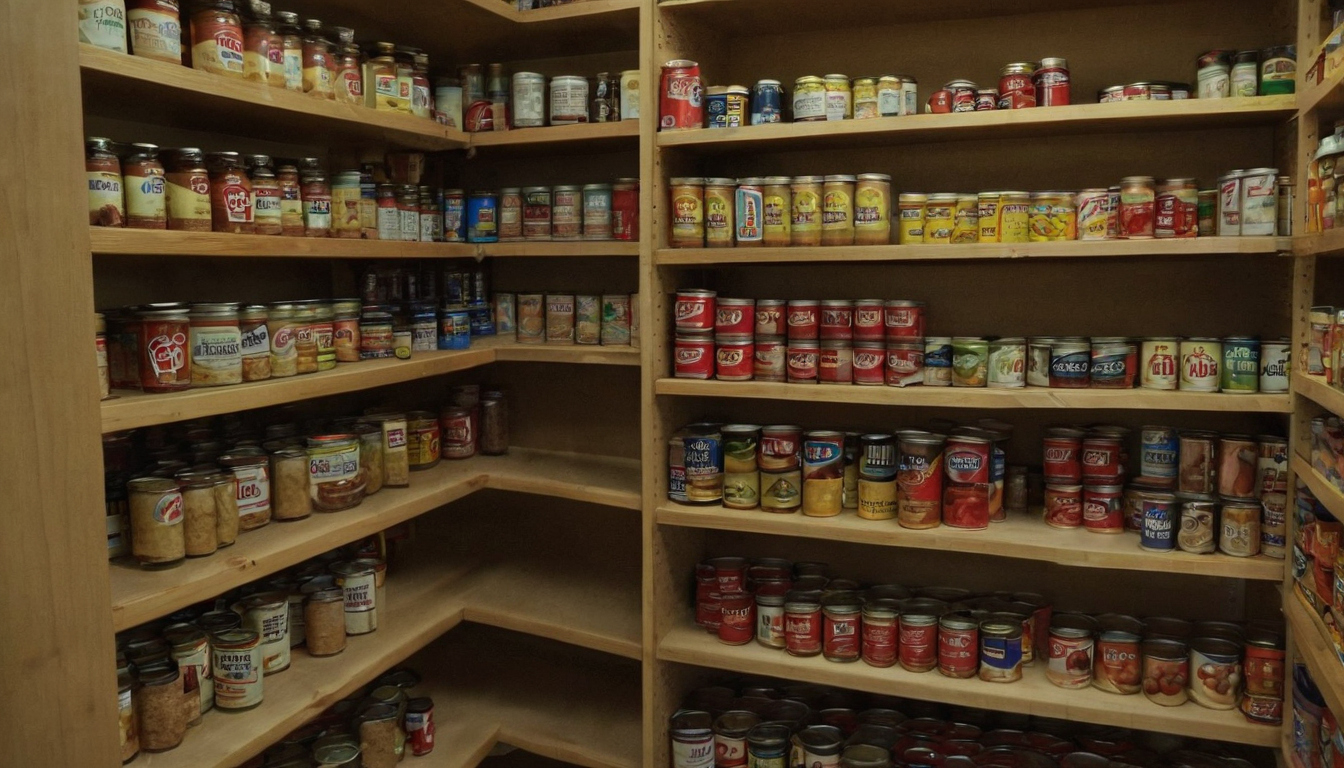
Particleboard shelves in pantry cabinets sag permanently under canned goods because sustained dead loads cause creep deflection beyond the material’s elastic recovery limit. A single row of 28-ounce tomato cans concentrates enough weight to bend unbraced 5/8-inch particleboard beyond acceptable tolerances within eighteen to twenty-four months.
Warning signs appear before the shelf collapses entirely. Watch for these indicators to avoid losing a weekend to broken glass and spilled beans:
Why standard particleboard shelves fail under canned goods within two years.
- A visible downward bow along the center span that does not spring back after you unload the shelf.
- Screws or shelf pins pulling away from the cabinet side panels, leaving elongated holes in the core.
- A spongy feel when you press down on the middle of the board with your thumb.
- Veneer or melamine coating cracking along the bottom edge where the board stretches under tension.
- Cans rolling toward the center of the shelf instead of sitting flat.
A 32-inch-wide shelf holding two rows of 28-ounce cans carries over 70 pounds of static dead load. Particleboard rated for light storage rarely handles more than 30 to 40 pounds per square foot without excessive bending. You expect a banker’s box full of files to be heavy. Canned goods put that same concentrated mass directly on the weakest point of the shelf span. Structural guidelines like the 2010 ADA Standards for Accessible Design specify precise clearances such as a 30 by 48 inch floor space for wheelchair positioning, reminding builders that exact dimensional planning governs accessible rooms. Pantry shelving calls for the same exact math for load capacity rather than guesswork.
Plywood resists creep because continuous wood grain layers spread the stress across long fibers. Particleboard relies on resin glue to hold small chips together. Under a sustained dead load of 40 to 60 pounds per linear foot, 5/8-inch industrial particleboard creeps at a significantly higher rate than 3/4-inch plywood of the same span. Building standards generally limit shelf deflection to L/360, meaning a 36-inch span should not bend more than one-tenth of an inch under load. Creep pushes particleboard past that limit quietly. You do not hear the shelf failing. You just open the pantry door one Saturday and find the middle touching the shelf below it.
Moisture speeds up this process. Unsealed edges absorb kitchen humidity, softening the resin and speeding up the slip between particles. A shelf that might survive three years in a dry climate fails in eighteen months near a stove or dishwasher.
How fast particleboard loses its shape under canned goods leads to the next comparison: how plywood, melamine, and MDF handle deflection limits across pantry spans.
Plywood, melamine, and MDF: comparing deflection limits for pantry spans
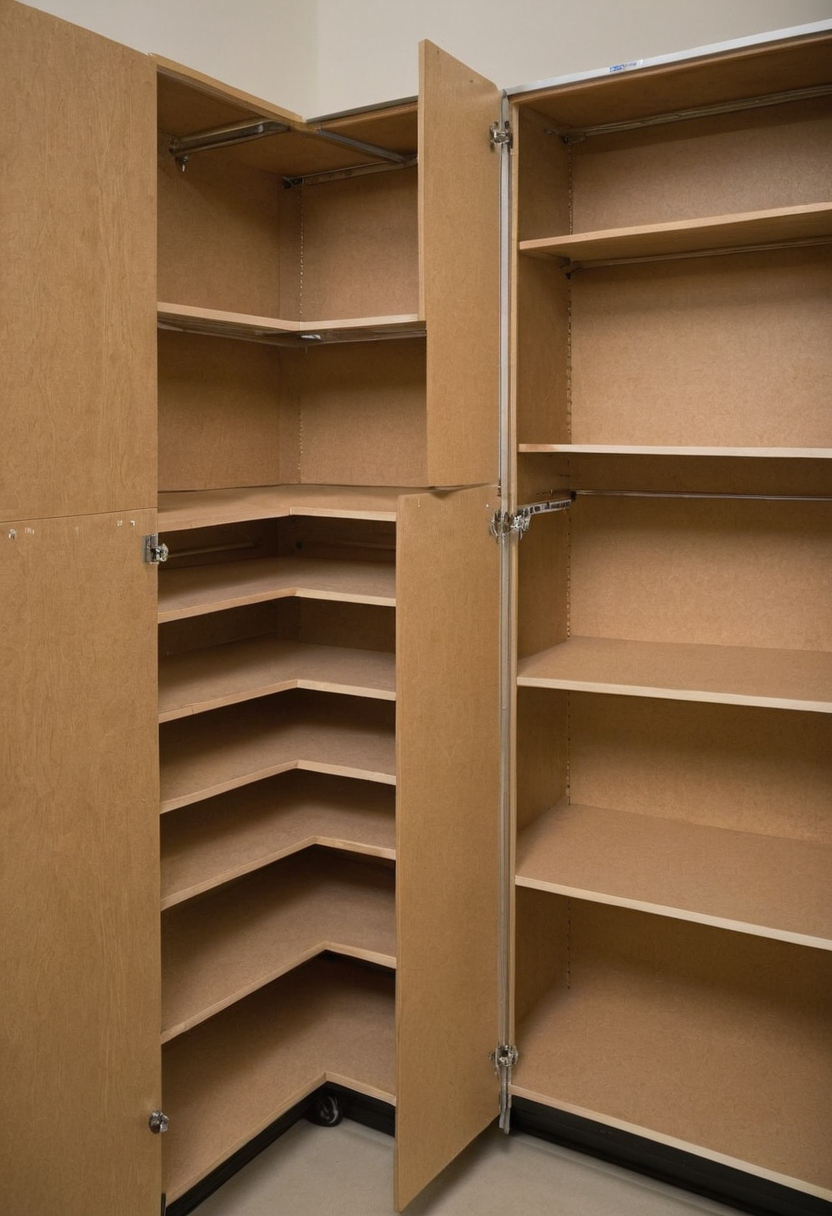
Plywood outperforms MDF and melamine-faced particleboard for pantry cabinet shelving because its cross-laminated veneers resist both immediate deflection and long-term creep under heavy canned-goods loads. For spans exceeding 30 inches without center supports, 3/4-inch hardwood plywood maintains structural integrity where MDF needs intermediate brackets.
Plywood, melamine, and MDF: comparing deflection limits for pantry spans.
Canned goods concentrate dead load in ways most shelf materials cannot handle over time. A single linear foot of tightly packed #10 cans or quart jars easily reaches 25 to 30 pounds. Stock cabinets for pantry use often ship with 5/8-inch melamine particleboard rated for far lighter duty. The material bends immediately under that weight, then creeps further downward each month until the shelf takes a permanent bow. Plywood resists this sequence. Its alternating grain layers spread point loads across the entire panel rather than letting them sink into a homogeneous core.
The U.S. Environmental Protection Agency identifies building materials, paints, varnishes, and furnishings as common indoor sources of volatile organic compounds (EPA indoor air quality guidance). That matters when you seal six sides of a shelf inside a closed pantry box. Choose low-VOC finishes or pre-finished panels so trapped off-gassing does not taint dry goods stored in breathable containers. Ventilation addresses part of the problem, but choosing the right substrate from the start reduces the chemical load inside the cabinet. The same precision applies to vertical placement; the 2010 ADA Standards for Accessible Design set accessible work surfaces at 28 to 34 inches above the finish floor, a useful baseline when deciding which pantry shelves need to sit within easy reach.
A 3/4-inch Baltic birch shelf spanning 32 inches between fixed supports holds roughly 60 to 70 pounds before visible deflection exceeds acceptable limits for food storage. A standard A-C hardwood plywood shelf of the same thickness and span handles closer to 45 to 55 pounds. Both numbers exceed 3/4-inch MDF, which begins sagging visibly around 30 pounds at that same span. Keep unsupported spans for canned goods under 32 inches regardless of the plywood grade. Add a center stile or a French cleat rail behind the back edge if the cabinet width requires a longer reach.
Edge treatment determines whether MDF survives humidity swings near a kitchen wall. Raw edges absorb moisture rapidly. Apply 2-millimeter PVC edge banding with hot-melt adhesive to all four edges before installing the shelf. Iron-on melamine tape peels away under repeated temperature changes. Thicker PVC wraps the substrate completely and blocks vapor intrusion better than paint alone.
| Material (3/4-inch) | Max safe span for canned goods | Approximate load limit at max span | Best pantry use |
|---|---|---|---|
| Baltic birch plywood | 32 inches | 60 to 70 lbs | Heavy jars, canned vegetables, bulk grains |
| A-C hardwood plywood | 30 inches | 45 to 55 lbs | Mixed canned goods, oil bottles |
| MDF (fully sealed) | 24 inches | 25 to 30 lbs | Spices, light plastic bins, dry pasta |
| Melamine particleboard | 24 inches | 20 to 25 lbs | Paper goods, empty containers |
These ratings assume fixed shelf pins or dado joints at both ends. Floating brackets cut the safe load roughly in half. If your pantry plan includes tall cabinet boxes reaching toward ceiling height, the shelves themselves are only part of the equation. The vertical side panels must stay square under uneven loading, or every shelf rating in this table drops the moment the box twists out of shape.
Cabinet box construction must resist racking when loaded unevenly
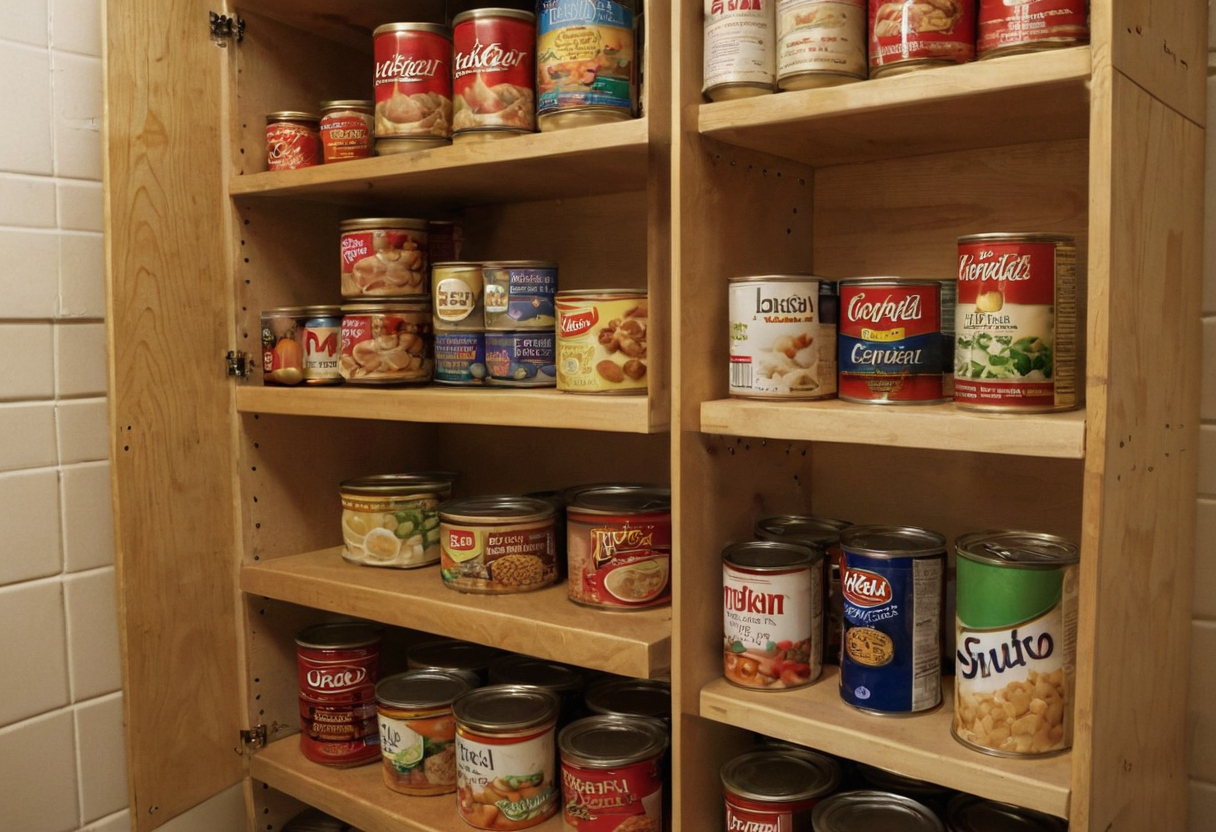
Pantry cabinets for kitchen use fail structurally not only from shelf sag but also from box racking when heavy canned goods occupy one side while the other remains empty. Dado joints, corner blocks, and properly placed back panels provide the lateral shear resistance needed to keep a loaded cabinet square against the wall. Spatial planning principles like planning reach zones and dimensional fit for closets address daily access, but a pantry carrying hundreds of pounds of canned goods needs structural rigidity first.
Cabinet box construction must resist racking when loaded unevenly.
A tall pantry cabinet loaded with thirty pounds of canned tomatoes on the left and nothing on the right acts like a lever. The box wants to twist into a parallelogram. Butt joints secured with confirmat screws or standard wood screws handle vertical weight fine. Those same butt joints offer almost no resistance to that sideways twist. A dado-and-rabbet joint cut into 3/4-inch plywood gives the mating pieces mechanical interlock. Glue inside a dado joint resists shear forces far better than glue on a flat butt joint because the wood fibers lock together across a larger bonded surface.
The back panel does more than hide drywall. A 1/4-inch hardboard back nailed every six inches along the perimeter adds some shear strength. A 1/2-inch plywood back screwed into the carcass edges turns the entire cabinet into a rigid structural box. That half-inch panel keeps the sides from leaning outward under an unbalanced load. Builders who skip the thicker back panel save material cost but lose the rigidity a pantry full of glass jars demands.
Rigid boxes keep shelves level, but sealed boxes trap moisture. The next question is how ventilation and sealants prevent pantry shelf warping in humid climates before the wood swells past the point where any joint holds.
Ventilation and sealants that prevent pantry shelf warping in humid climates
Unsealed MDF and particleboard swell and lose fastener holding strength when relative humidity consistently exceeds sixty percent. Sealing all six sides of pantry shelves with polyurethane or using pre-finished moisture-resistant core materials prevents edge swelling, while passive ventilation grilles equalize air pressure inside enclosed pantry cabinets. Climate control in the kitchen extends beyond the countertop; managing kitchen humidity for bread storage follows the same principle of keeping ambient moisture away from porous materials.
A sealed cabinet box traps the same moisture that destroys unsealed panels unless you give the trapped air a way out. Pantry cabinets for kitchen installations near dishwashers, sinks, or uninsulated exterior walls absorb more moisture than bedroom closets. The EPA recommends keeping indoor relative humidity below 60 percent, ideally between 30 and 50 percent, to prevent mold growth and moisture-related material degradation in enclosed spaces (EPA moisture guide). Reaching that baseline inside a closed cabinet requires either mechanical extraction or deliberate passive airflow.
Silica gel desiccant packs handle short-term spikes when ventilation alone falls behind, such as during a week of heavy rain or a plumbing leak next door. Desiccants saturate quickly in a fully sealed box. They work best alongside passive vents, not as a replacement. Check and recharge indicator silica beads every few months by baking them according to manufacturer instructions.
Fresh sealant also introduces chemicals into the space. The U.S. Environmental Protection Agency recommends increasing ventilation when using products that emit volatile organic compounds indoors (EPA VOC guidance). Cure oil-based polyurethane shelves outside the cabinet or leave the doors open with fans running until the off-gassing stops before loading food.
ASTM D1037 includes a six-cycle accelerated aging test that subjects wood-based panels to repeated wetting and drying to evaluate long-term structural degradation from humidity swings (ASTM D1037). Panels subjected to six cycles of water soaking, steam, freezing, and oven drying reveal how fast unprotected edges fail compared to sealed ones. The same standard provides test methods for measuring fastener withdrawal resistance, which determines how well hinges and shelf pins hold in particleboard after moisture exposure reduces internal bond strength. Screws driven into swollen particleboard pull out under loads they held easily when dry.
| Edge treatment | Adhesive type | Moisture resistance | Heat tolerance | Best pantry application |
|---|---|---|---|---|
| PVC banding | PUR adhesive | High | Up to 300°F | Heavy canned-goods shelves |
| ABS banding | PUR adhesive | High | Up to 300°F | Moisture-prone lower cabinets |
| Wood veneer | Hot-melt EVA | Low | Up to 180°F | Upper dry storage only |
| Melamine tape | Pressure-sensitive | Moderate | Room temperature | Temporary patch repairs |
Sealed edges and ventilated boxes keep the cabinet structure intact, but the moving parts inside that box have their own clearance requirements once you start stacking mason jars and pulling trays. Size pull-out drawers and lazy Susans around actual jar clearances so your pantry organization survives daily use without binding or scraping the sealed panels.
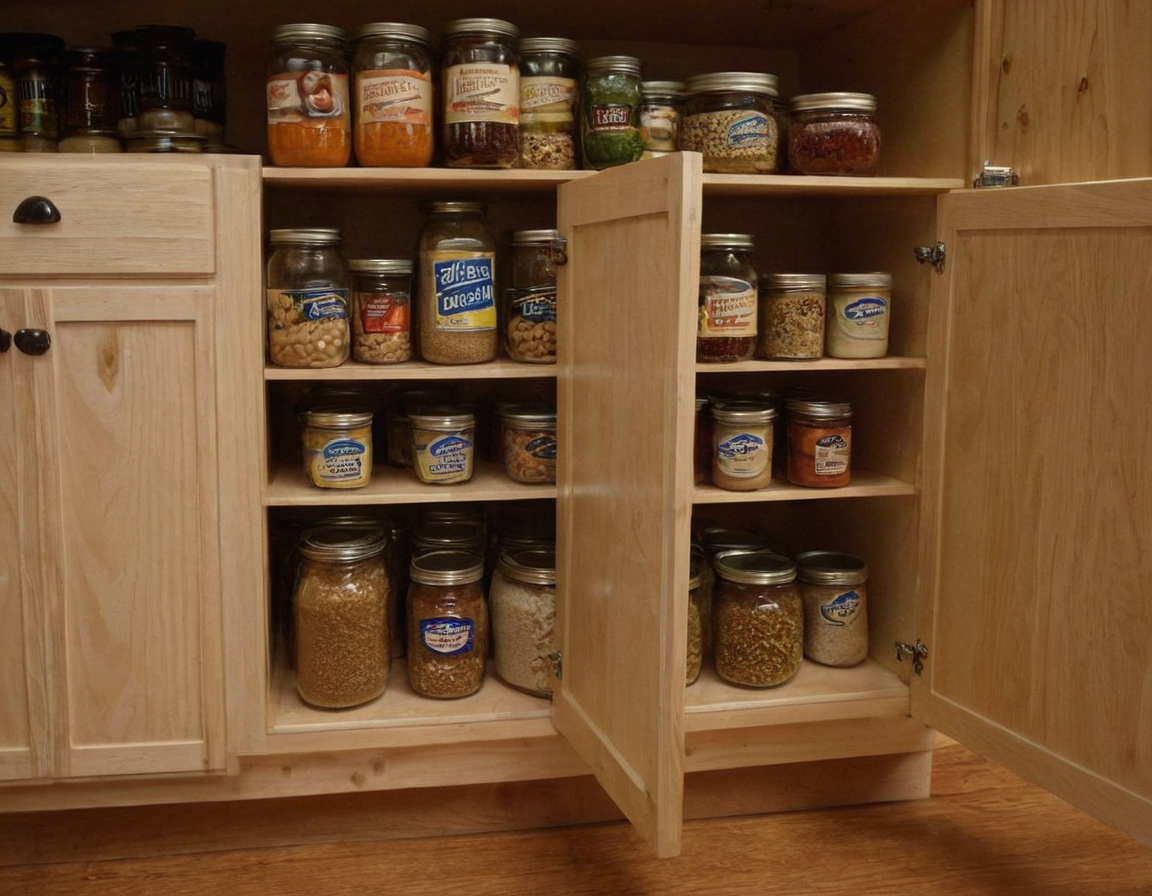
Ventilation and sealants that prevent pantry shelf warping in humid climates.
Sizing pull-out drawers and lazy Susans around actual jar clearances
Pull-out drawers and lazy Susans in pantry cabinets require precise dimensions based on the height of the tallest stored items plus slide mechanism clearance. Standard full-extension drawer slides rated for one hundred pounds accommodate most canned goods, but heavier bulk storage demands undermount slides rated for one hundred fifty pounds.
A standard quart mason jar stands about seven inches tall. A number ten can reaches nearly seven inches. Add a half inch for finger clearance above the rim, then another inch for the drawer bottom thickness and slide hardware. A shelf opening needs at least nine inches of vertical space to accept these jars without scraping lids when you push the tray back.
Lazy Susans carry weight differently than straight drawers. A full-round turntable distributes load evenly across its central bearing. A kidney-shaped shelf leaves a gap for cabinet door clearance, shifting weight toward the outer edge. That offset strains the pivot point. Load a kidney shelf with heavy items like oil bottles or canned tomatoes near the center hub, not the rim. Check the bearing rating from your hardware supplier before stacking dense goods.
Use this checklist before drilling holes for pantry organization:
Getting these measurements right keeps glass jars intact and prevents slide failure. Hardware limits are only half the problem. You also need to decide whether your carpentry skills match the job: should you hire an installer or build those pantry cabinets yourself over a weekend?
When to hire an installer versus building pantry cabinets over a weekend
Building DIY pantry cabinets works when you have access to a track saw, understand lumber grading, and can verify stud locations for French cleat mounting. Hiring a professional becomes necessary when walls are out of plumb by more than a quarter inch, plumbing runs behind the intended cabinet space, or local codes require permitted built-ins.
A track saw and a straight edge cut 4×8 sheets of three-quarter-inch plywood cleanly enough for cabinet boxes. A circular saw with a clamped guide leaves chipped edges on veneer plywood that show through paint. You also need a pocket-hole jig or biscuits for joinery, a reliable level, and a drill driver capable of sinking three-inch structural screws into wall framing. Without any one of these tools, you must buy it or accept sloppy joints that fail under canned-goods weight.
Material costs for a basic DIY pantry run between $400 and $900 depending on plywood grade and hardware choices like full-extension drawer slides. Custom cabinet installers typically charge $2,500 to $6,000 for a comparable reach-in pantry, covering both labor and materials. The price gap pays for scribed filler strips that hide wavy drywall and shelf pins drilled perfectly square.
Most US residential jurisdictions do not require a building permit for freestanding pantry cabinets. Built-in cabinetry bolted to studs sometimes triggers permit requirements if the project alters structural backing or electrical runs. Check your local building department before anchoring tall units permanently.
The tradeoff is time against precision. A weekend build saves money but requires you to measure twice for every cut, especially when sizing pull-out drawers around actual jar clearances. If your walls bow or your schedule is tight, the installer earns their rate by delivering a box that sits plumb and holds the load without shim stacks. Choose the path that matches your tools, your walls, and your patience for measuring twice.
For more on this topic, see other guides on this site.